
AI driven business is no longer optional; it’s a strategic necessity for organisations of every size. But adopting AI isn’t about incremental improvement, it’s about fundamentally transforming how we approach growth.
If you’re a consultant, coach, business owner, or solo entrepreneur feeling the seismic shift of artificial intelligence, this guide is your strategic foundation. Drawing from Part 1 of my book – The AI Business Accelerator – this article will help you move past the hype and start building strong foundations for leveraging AI to work smarter, perform better, and profit faster.
PREFER TO LISTEN?
Setting the Right Mindset for AI Transformation
Since the launch of ChatGPT in November 2022, AI has marked a watershed moment that fundamentally alters what’s possible in business. But adopting AI is not just about adding a few new tools—it’s about transforming how we think about growth itself.
The temptation is strong to chase AI shortcuts. But the truth, confirmed time and again through practice and research, is this: AI reaches its highest potential when it’s an ally to human endeavour, not a substitute. We must approach it with both excitement and critical awareness.
To guide this transformation, I developed the AI Business Transformation Model—a four-point compass that helps you align and navigate your AI initiatives across:
-
Strategic Goals
-
Process Changes
-
People Development
-
Cultural Readiness
Success comes not from excelling in one area, but from maintaining alignment across all four. This model helps you move progressively through four phases of maturity: from Traditional Operations, to AI Enhancement, through Process Optimisation, and ultimately toward Scalable Solutions.
By taking a gradual, iterative approach, you can maximise benefits while mitigating risks. When implemented effectively and ethically, AI doesn’t just improve efficiency—it redefines what’s possible, creating more customer value, enhancing brand experience, and unlocking new scalability.
AI in Action: Dual Engines Driving Business Growth
Think of AI as your ultimate, tireless assistant—capable of handling tasks that would otherwise consume your time or budget. For small to medium-sized businesses, this means doing more in less time, with greater precision and creativity.
To understand how AI works in practice, it’s helpful to see it as two complementary engines:
- Traditional AI is your steady power source. It excels at data processing and predictive analytics, driving consistency, automation, and optimisation.
- Generative AI is your creative wind. It produces human-like content—text, visuals, code—and opens up new possibilities for expression and innovation.
The real acceleration happens when these two engines work in harmony. For instance, traditional AI might identify emerging customer needs, and generative AI can then create personalised content that speaks directly to those insights.
Here are just a few of the tangible ways businesses are using AI today:
- Customer Insights and Personalisation: Mining vast data to tailor products, services, and campaigns, boosting loyalty and engagement.
- Chatbots and Virtual Assistants: Offering 24/7 customer support, handling routine tasks, and improving responsiveness while lowering costs.
- Content Acceleration: Using tools like ChatGPT to brainstorm, research, draft, and optimise marketing copy—freeing you to focus on higher-value strategy and creativity.
- Online Course Creation: Streamlining course design, structure, and content development, accelerating the entire production process.
AI won’t replace human ingenuity, it will amplify it.
When you integrate it strategically, AI becomes a multiplier of human creativity and business performance.
Building Your AI Implementation Strategy
Successfully implementing AI requires more than enthusiasm. It demands strategic rigour and a healthy dose of scepticism. Since AI is trained on “everything on the internet,” it can reproduce errors, biases, or misleading information.
Your job, as the expert, is to use AI as a thinking partner—to brainstorm, explore, and accelerate—but always through the lens of your professional judgement. Style its output for your audience, check the facts, and inject your unique expertise and voice.
AI adoption follows a cyclical lifecycle: assessment, development, deployment, and optimisation. To make progress fast but safely, start small and build iteratively.
Here’s a pragmatic roadmap for getting started:
- Identify Business Bottlenecks – Pinpoint specific challenges where AI could have the biggest impact.
- Explore AI Solutions – Research tools and systems aligned with your needs, budget, and goals.
- Prepare Your Data – Ensure your information is clean, accessible, and structured for analysis.
- Integrate and Train – Implement your chosen tools and provide your team with hands-on learning.
This leads us directly to building your AI literacy. Start by exploring tools like ChatGPT. You can create a free account at chat.openai.com.
As you gain experience, you’ll learn to craft effective prompts moving from multiple iterations to getting the desired output in one go. This specialised skill is known as prompt engineering, and is key to getting powerful, precise results with your AI driven business development work.
For greater effectiveness, you can also train AI on your proprietary data—your brand voice, frameworks, and customer insights. And you can do this by uploading any of your own material that you own copyright on. Customising your AI knowledge base gives you a significant competitive advantage over those using generic tools.
If you’re concerned about intellectual property, use private chat options or disable data sharing features in your AI tools (for instance, toggle off “Improve the model for everyone” in ChatGPT settings).
The more you use AI as a collaborative partner—testing ideas, stress-testing assumptions, and refining strategy—the more it sharpens your thinking and magnifies your impact.
Measuring ROI: How to Track the Value of AI
Every strategic initiative needs a way to measure success, and AI is no different. Pursuing AI without a clear evaluation framework is like setting sail without a compass.
Start with clear goals and key performance indicators (KPIs). Your metrics will vary depending on your organisation’s priorities, but both quantitative and qualitative indicators matter.
The true measures of success are unique to your organisation’s specific challenges and goals. The ROI monitoring process involves tracking, measuring, and optimising your AI strategy. This is no different to marketing ROI – a lot of people just aren’t looking at how much of their marketing is actually delivering real, tangible results for your business.
Evaluating these things requires both quantitative and qualitative metrics. Don’t just focus on revenue growth: consider efficiency improvements and customer-centric benefits. They all impact your bottom line.
Typical measures include:
- Conversion Rate Optimisation – How effectively are leads turning into customers?
- Revenue Growth – What portion of new income can be linked to AI-enhanced campaigns or recommendations?
- Cost Savings – How much time, labour, or outsourcing cost has automation reduced?
- Customer Satisfaction and Retention – How is AI improving the customer journey and loyalty?
The objective is to harness AI to drive demonstrable business value. The future of business is increasingly AI driven, and by identifying opportunities, adopting a strategic and iterative implementation plan, and committing to building your AI literacy, you focus yourself to survive and thrive in the age of AI.
Remember that ROI from AI rarely happens overnight. It’s a long-term, iterative process of testing, learning, and refining. The key is to start with quick wins, monitor performance closely, and keep evolving your approach as the technology and your business both mature.
The Path Forward: Building AI Confidence and Capability
The future of business is undeniably AI-driven. Those who thrive will be the ones who understand how to align AI with their strategy, operations, and culture—not just their technology stack.
By identifying opportunities, developing a disciplined implementation plan, and investing in your AI literacy, you position yourself to not only survive but truly accelerate in this new era of business.
If you’d like to take the next step, you can download my AI Getting Started Checklist and the AI Business Accelerator Implementation Toolkit—two practical resources to help you map your AI journey with clarity and confidence.
Both are available free from The AI Business Accelerator book resources page: Free AI Guides.
The AI driven business revolution has already begun. Embrace it, explore it, and let it propel your business to new heights of success and impact.
Jay’s latest bestselling book
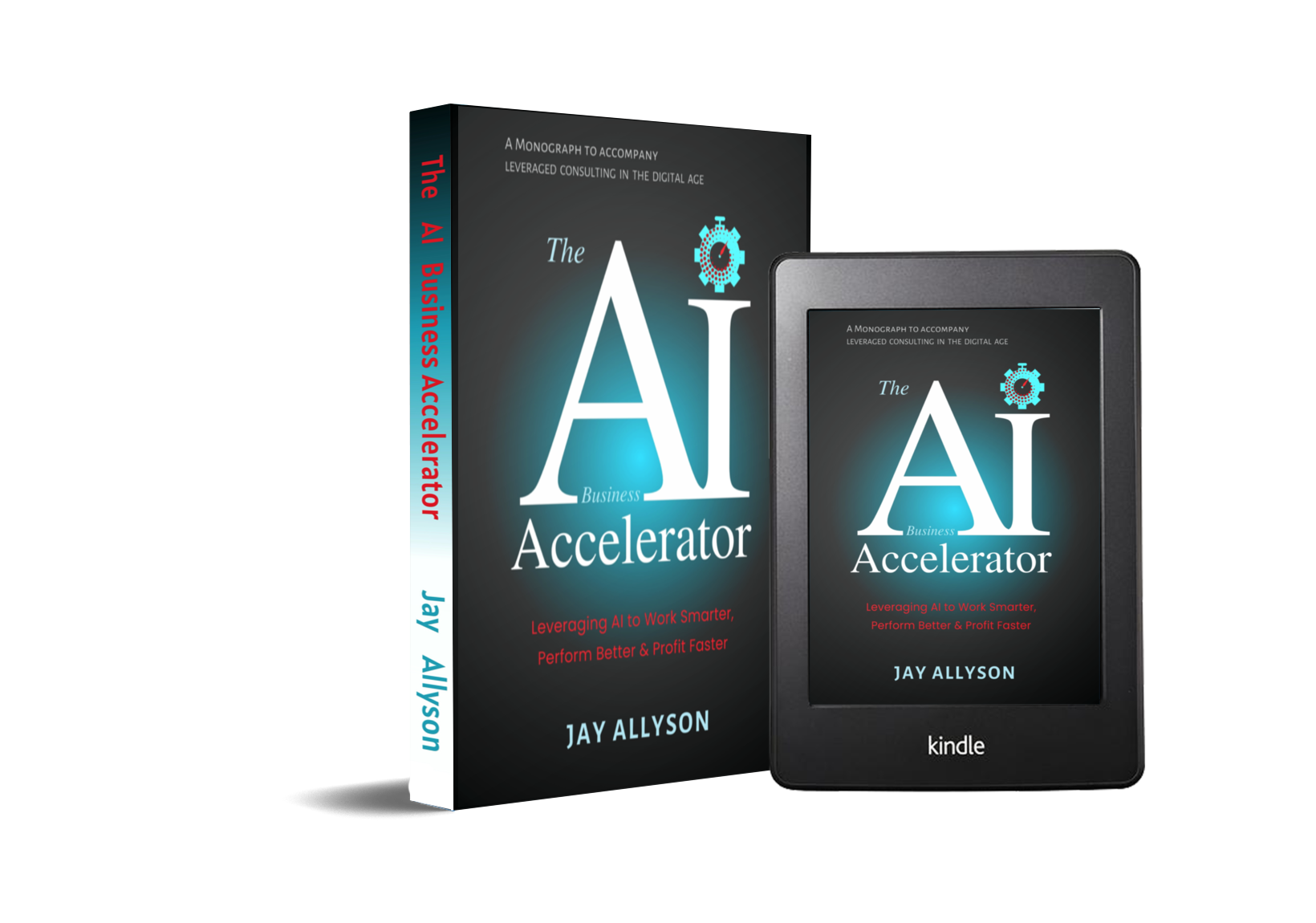
The AI Business Accelerator: Leveraging AI to Work Smarter, Perform Better & Profit Faster
Published January 2025
Your essential guide to leveraging artificial intelligence strategically for tangible business results. Learn how to identify high-impact AI opportunities, implement solutions that drive real ROI, and build sustainable competitive advantage while maintaining ethical practices.
NOTE:
The podcast episode based around this same content provided experiment number 2. (The first was episode 127.)
Whether you’re a coach, consultant, or small business leader, this episode gives you the roadmap to implement AI thoughtfully, ethically, and profitably – so you stay ahead of the curve, not caught behind it.
And yet, this episode is AI podcasting experiment no.2. The first part is AI-generated based on chapter 1 of my book The AI Business Accelerator. But unlike last episode where I used NotebookLM to generate a conversation between two presenters (talking about me, quoting me … ), this time I uploaded my own voice as an audio template into Descript along with an AI-generated script summarising Chapter 1, which is what I wanted to talk about.
I subsequently recorded the same material myself – human-generated, where I could add my own flair and riff off the script. (I guess I can enhance the AI version by giving it more direction ….) But it’s interesting what I did well and not so well.
I’d love to hear your views on this, especially as it compares to last episode 127’s conversational analysis based on the book’s introductory chapters.

Book a Discovery Session with Jay
This is a 30-minute session - and completely without obligation, no sales. It's purely to get you clear on your single next best step to focus on, strategically. Together, we talk through your business goals, current issues and we'll go through some of the key dimensions you need to consider that make the difference to achieving the success you want. We look at your marketing and your sales process to see which areas of improvement can have the the biggest impact. From that vantage point, you will know where to put your efforts and what kind of support you need to help you success with speed.


